Project Phoenix

I was gifted a lovely little radio a while back – a Yaesu FT-270R.

It’s an old 2m model, dating back to the late eighties, I’m guessing.  As such, it lacks CTCSS capability, which limits its use somewhat.

However, there is a space inside to fit a FTS-8 subtone encoder board. And so I thought I’d fit one of these and give it a new lease of life.

Sadly though, the FTS-8 board is no longer available and secondhand ones command a hefty price tag.

What to do? Well, make one of course!

I found an elegant design on the web and built it onto a piece of veroboard. Plugging it into the radio, changed some of the available functions, so the radio obviously detected the board.

It allowed me to choose the subtone from the front panel. Excellent.

But it didn’t work.  Checking  the output with my scope, the tone just wasn’t there… or rather, it wasn’t what it should have been.

I spent ages fiddling with it, but ultimately could find nothing wrong.

And so I passed it onto Dave, who – being a clever bugger – worked out pretty quickly that the board I had built actually worked perfectly. Unfortunately, the radio didn’t. It was giving out the wrong signals to the board.

This wasn’t something that could be easily fixed – possibly a microprocessor issue. And so, I figured a workaround, that would allow the tone to be selected manually, using a combination of switches to produce the binary equivalent of the hexadecimal value that the board was looking for in the tone lookup table.

This worked perfectly and when I tested it, I was successfully able to open several different repeaters, all using different subtones.

And then I found a bug, where the tone would only change after five minutes and not whenever the PTT was keyed.  This looked to be a fault with the MCLR on the PIC… possibly damaged by putting in 7.6 volts from the radio (datasheet states that Vpp shouldn’t exceed Vcc). Not having another chip available, I made a slight mod and fitted a miniature relay, which only allowed the board to be powered when the PTT was depressed.  This seemed to work nicely and I was able to switch tones easily and on-the-fly.

So, I put a call out on a repeater. “Your audio is awful!”, I was told.   I replaced the mic ( a new one from ebay cost fifty quid! Yes, fifty quid for a 30 yr old mic!) with an old YM-47 from an FT-290 and it worked perfectly… once I had figured out the differing wiring scheme.

And so, after many weeks of working on it, on and off, it is ready to be put to use.

Not that I need another radio at the moment, so a friend is going to borrow it.

Many times I nearly gave up on it and was going to throw it away. But, I had invested a lot of time and a reasonable amount of money on it and so I wanted to see it through.

I’m pleased that it is finally finished and working… because that means I can now move onto my next project 🙂

Chinglish

For something to do, the other day, I built a small function generator.

You know: one of those boxes that can generate a sine, square or saw-tooth waveform at varying frequencies.

You know the ones.

Anyway, it’s nothing fancy: just a kit from ebay.

For a fiver.

Yes, a function generator for five quid! It even comes with a perspex box to put it in!

Obviously, it’s Chinese and so the quality is a bit dubious at that price.

But it works fairly well.

Despite the building instructions:

“After completion of welding on IC, insert the might damage the chip!”

“Check the IC whether against, such as anti please timely correction.”

etc

Google Translate has it’s limitations, I think.

M:I-2… end of an era?

Back in 2012, I made a six-part Geocache, consisting of a series of electronic puzzles to solve.

I called it Mission: Impossible – 2  (it was the sequel to the original Mission: Impossible cache I’d made 18 years ago).

These puzzles were hidden around the countryside in a five-mile radius from my home. Each puzzle – when solved – would lead to the next, culminating in a final devious puzzle which – when solved – would unlock to reveal a logbook to sign and some cache-type goodies to take away.

As I had made it a Premium cache, meaning that only serious fee-paying cachers could play – and also because all the puzzles required batteries, which would need to be supplied by the visiting cachers – I never expected this cache to get a great deal of take up and thought it would probably only last six months or so.

How wrong I was.

OK, it didn’t get the amount of traffic a non-premium cache might have got, and a lot of people who did look at it (I could see how many, from the audit function that Groundspeak now sadly seem to have removed) possibly dismissed it due to the time it would take to complete – roughly a day: a lot of cachers are in it for the numbers and would rather get 6 quick wins in a day, than have to spend all day working for just one.

But, it was completed by a goodly number of cachers, who all thoroughly enjoyed the experience, judging by some of the logs:

“I would give this cache all 10 of my favourite points if I could! ” – L********61

“Wow Wow Wow.  done over 2 weekends with Morn.   we laughed we nearly cried at one stage…” – A***s T********e

“Stage 5 almost caused a divorce… Brilliant cache, great fun…”  – R****54

“Everything about this cache was extraordinary, innovative and impressive. ”  – Mr & Mrs M*****

“We had a lovely afternoon following the clues. I wish there were more caches like this one.”  – K****y + L***a

“What a sense of achievement to reach and complete the final stage of this wonderfully inventive multi-cache.” – A********s

“Ahha… Finally thwarted the Evil Professor Masher!! …  This is truly a great series, probably the best caches I have ever seen.” – G*****1

“This has to be one of the best (if not the best caches) I’ve ever found in my 10+ years of caching so awarding this a well deserved favourite point , would be more if I could.” – M*d H***r

“Caches like this don’t come along too often and giving it one favourite point just doesn’t do it justice. Tremendous fun…” – P******e

“BRILLIANT!, BRILLIANT!, BRILLIANT!……oh, and did I say this cache is BRILLIANT!!!” – The O****s

“You’re a genius Prof Masher and we salute you.” – The N***y C**w

etcetera, etcetera, as the King of Siam might say.

It was even nominated in the Best Cache category at the 2016 National Geocaching Awards (Britain & Ireland). It didn’t win (I don’t think enough people had played) but I was pretty chuffed to be nominated anyway.

But sadly, after seven and a half years, Mission Impossible 2 is no more.  Stage 2 went missing last year, so I reworked it to make the cache into a five-parter.  But then Mrs Masher found Stage 3 damaged beyond repair, when she was out walking the dog a few weeks back. As such, I have archived it, but sadly, stages 1 and 4 were stolen before I could even recover them.  Stage 1 was always a personal favourite, as it set the scene for the whole game. A short video of it can be seen here.  Use the password: Ge0cach3!  (Trivia note: the voice you hear, is that of our very own Mr Jones).

Mission Impossible 3 is almost finished and is nearly ready to roll out. I’ve spent the past two years building it – not the entire two years, obviously; just here and there when I had the time.

The theft and vandalism though, make me wonder whether I should bother (The original Mission: Impossible cache went the same way, fourteen years ago).

But, every so often I’ll take a read through those logs and be inspired to get it finished and get it out there.

We’ll see.

M… m… m… my corona

I buy a lot of stuff from China.

Just small stuff.

Electronic components, in the main.

Because they’re cheap and are all over a well-known auction site.

In the past, even the postman has moaned to me about all the “… stupid little packets from China…” that he has to deliver to our house.

One such package arrived yesterday: a small Bluetooth module for a forthcoming project.

“Is that from China?” asked Mrs M.  I nodded. “Well, make sure you wash your hands after handling it, she said, in obvious reference to the Corona Virus outbreak.

“Oh, don’t be daft”, I said very matter-of-factly, “It’s absolutely fine. There’s no way a virus could survive a three-week journey through the postal system.” I continued… as if I actually knew what I was talking about.

Then I took the package upstairs to the shack, where I stopped briefly in the bathroom, to wash my hands and spray some Dettol on it.

Can we fix it?

Yes we can!

This weekend has been a time for fixing things:

The external speaker that I connect to the radio in my car, has been intermittently playing up for the past couple of months and I just keep forgetting to look at it. But today, I have fixed it! I replaced the cable and it no longer sounds like Norman Collier (now, there’s one for the kids!) and the sound quality has actually improved as well. That old cable must have really been rubbish!


Now, when I put down the concrete base for the new shed a couple of months back, I accidentally tripped and – to stop myself falling face-first into the wet cement – I grabbed at the nearest thing to steady me. That nearest thing was my active loop aerial, which didn’t take my weight particularly well. It has been broken ever since. But yesterday, I dragged it indoors: if the soldering iron can’t get to the mountain, then the mountain must come to the soldering iron! I repaired the circuit board, put it all back together and then added some clear silicon sealant around the entrance holes. It’s now all working good as new, again.


For Christmas, Santa brought Son  a new bike. Unfortunately, on it’s way from Lapland (Halfords), the handlebars got twisted in the back of my sleigh. Also, we discovered that the rear brakes squealed like a pig being chased by a former Prime Minister.  Although it is obviously under guarantee, getting it back to Lapland would prove difficult, and so yesterday I set about it with my toolkit.  Rides like a dream, now.


Finally, there is my bench power supply.  I built this in 1980 from Practical Electronics magazine. It has given faultless service, until just a couple of weeks ago, when it just decided it didn’t want to play any more. I did consider just buying a new one, as they are relatively inexpensive nowadays, but then I thought I’d have a go at fixing it – I get a lot of enjoyment from fault-finding and fixing things… although maybe not so much when I can’t figure it out and can’t fix it! But this was pretty easy in the end.


Turns out the primary windings on the mains transformer had never been soldered on to the tags. Upon inspection, it seems the enamel coating hadn’t been properly scraped off either. It had obviously come like that from the manufacturer. In all, I’m surprised it worked for as long as it did. But it did. For 39 years! And now that I have properly made those connections, I might just get another 39 out of it!

Guilty, As Charged

I do wonder about myself sometimes!

Last night, I built a wireless charger for my phone.

It took about a week for the bits to arrive from China, and then about an hour for me to fit it into a suitable container that would act as a charging pad – I used the lid off of a jar of decaffeinated coffee.

My schoolboy error?

My phone doesn’t do wireless charging!

Oh well, at least it was quick and cheap. And it hasn’t gone to waste, as Daighter’s phone does have that functionality, so she has already snaffled it away to join the junk on her bedside table.

*Must do better research next time*

Hit It!

For ages – and just for the fun of it – I’ve wanted to build a Batak.

I think that’s short for Button ATtAcK.

I think.

Basically, it’s a reaction game: a button lights up and you press it, and then another lights and you press that, and then anoth… well, you get the idea.

All against the clock.

They are used widely in Formula 1, I believe, to help the drivers improve their reaction times. It takes speed, hand-to-eye co-ordination and good peripheral vision.

I’ve always thought that building one wouldn’t be too difficult, but my programming skills are THAT rubbish, that I could never quite figure out how to do it.

And then I spotted a project to build one, on the Instructables site, by a clever chap called R0RSCHACH and I have pretty much copied his design exactly, but then added a few little bits so that it can either run off of a 12V battery or can be plugged into the mains.

OK, it’s not as impressive as a proper Batak, I suppose, but it does the job and it only cost me about fifty quid to build. Proper ones go for hundreds or can be hired for several hundred a day!

It’s been a lot of fun building it and I’ve learnt quite a lot too  -though my programming skills are still rubbish.   My woodworking skills aren’t much better and the wooden framework probably took me longer to build than the electronics (big thanks to my mate Graham, who helped with the woodworking side of things).

And does it work?  Well, it’s against the clock, as I said, and the most I have managed to score is 42 (yes, I know: the meaning of life, the universe and everything). Daughter, however, has managed 62… which is really annoying!

Bloody kids!

So, now that’s built, I need another project to keep me busy.

“NEXT!”

All Hi and no Fi

Well, it wasn’t the way I planned to spend my Sunday afternoon , but it was enjoyable, nonetheless.

My aging Pure Legato II Hi-Fi started playing up a while ago, giving me its own equivalent of the Blue Screen Of Death: it’s LCD panel, lighting up of its own volition and then refusing to do anything whatsoever.

A factory reset brought it back to its senses, but it didn’t last long and it died again, last week.

I was going to try re-installing the firmware, but Mrs M wanted a quick fix, as she can’t do her ironing without loud music.

Very loud music.

And so, as a temporary measure, I got one of my old amplifiers out of the loft: the venerable Arcam Alpha 5, from the nineties and connected it up to the Sonos system in the living room.

It worked brilliantly… out of one speaker.

The other speaker was quieter than a church mouse with slippers on.

Hmmm… I’m sure it was all working fine when I put it away, all those years ago.

I took the lid off and had a poke around inside. There was nothing obviously wrong, that I could see and so I squirted some switch cleaner onto the switches and pots and gave them a twiddle… wouldn’t do any harm. But still, the left channel refused to make any kind of sound.

And then I noticed the output fuses. I removed and checked them both, only to find that they were intact.

But, when I put them back in, both speakers suddenly sprang into life! I’d fixed it! Yay, me.

I tried wiggling the fuse-holders to see if there was a dodgy joint, but I couldn’t replicate the fault. Maybe it was just some oxidation on the fuse holder blades, I don’t know, but either way it was working, so I put it all back together and fitted it inside the cabinet.

For good measure, I replaced the speakers with something a bit oomphier: a set of Tannoy Revolution R1s.

OK, it took several hours to get it all up and running properly, but Mrs M is happy: she doesn’t care that the sound quality is better than the old one, or that the treble attack is that much faster; she’s just pleased that it’s that bit louder than before.

Count your blessings

 A young chap at work has the enviable task of talking to members of the public about the Water Board’s plans for the area.

I say ‘enviable’, but he enjoys it. He’s that sort of chap. It doesn’t appeal to me at all. Horses for courses and all that.

But, he was telling me that when he goes along to an event and sets up his tent, he has no-way of keeping track of how many visitors he has had and whether the experience has benefited them at all.

So, I built him a counter. Just a simple thing, shown in the picture attached to this post.

It only took me a weekend to build the electronics and fine-tune the software that someone cleverer than me, put together.

However, it then took many weekends to design and build a wooden box to put it in.

Far too many weekends.

Because my woodworking skills suck. As you can see.

So, I was somewhat apprehensive when I presented it to him last week.

But, he was over the moon.

Genuinely.

Exactly what he needs, apparently.

Other ideas for its use, have been offered up from other parties who have seen it in the office and I feel that I might get commissioned to build another one.

I’m happy to.

Happy to do the electronics, but someone else can build the bloody box for it!

Watch this!

This is my wristwatch.

Well, it’s one of my wristwatches. I have three.

This is my day-to-day work watch. It’s solar powered, so doesn’t need winding.

I also have a weekend watch. Same make, but slightly more expensive, waterproof and powered by kinetic energy.

The third is my dress watch, the one I wear to weddings and funerals. It too is solar powered, waterproof and it is synced via radio to DSF77, the time signal broadcast from Germany.

I don’t wear jewelry of any kind… apart from a wristwatch… which I wear all the time (pun not intended, but unavoidable).

Without one, I feel naked.

You get what you pay for

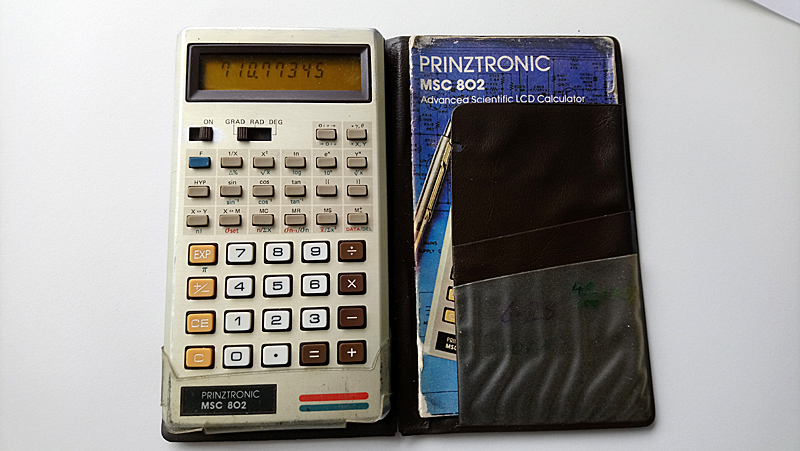
This is the calculator that I use at work.  I took it out of my desk drawer specifically for this photo. And I wrote SHELLOIL on it, because it would have been infantile to have written BOOBS… and – contrary to popular opinion – I am a grown up.

I bought this calculator… actually, I didn’t – my parents bought me this calculator to do my college exams with.  I remember going into Dixon’s with my mum, and I remember her wincing at the price when I picked out the one that I wanted.

But, I’ve always been one to look after things and so this calculator – though it’s somewhere around 38 years old – still works perfectly. And it even still has the original instruction manual, tucked into its imitation leather, plastic wallet.

It got me through my electronics exams.

It got me through my Radio Amateur’s exam.

It even got me through the mathematical questions they suddenly threw at me, at my job interview for the GPO/British Telecom.

OK, yes, I’ve had to change the batteries and clean up the PCB, but on the whole, mum, I think I got your money’s worth.

ShackBox

I’ve been busy over the weekend.

Doing the usual weekendy stuff: cutting the grass; cleaning the bathroom; fixing the stupidly-expensive cordless hoover… that sort of thing.

And also, building this little project from April’s Practical Wireless.

G0PJO’s wonderfully simple design was a joy to build… and cheap too!

I think total cost was about 22 quid and that gives me a highly accurate clock, along with Latitude and Longitude coordinates; temperature and air pressure readings and a Maidenhead Locator too! It will even show WAB squares… if I wanted it to, but I didn’t, so a quick tinker with the very well-documented code switched off that particular function.

If you are looking for a quick and simple – but worthwhile – project to get the soldering iron going, then I can heartily recommend this.